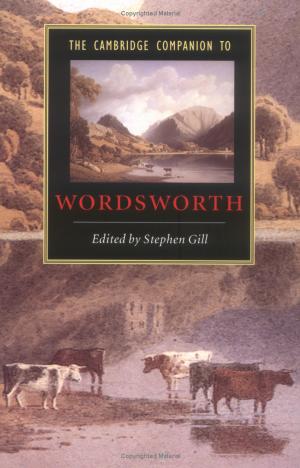
The Cambridge Companion to Wordsworth by Stephen Gill
Author:Stephen Gill
Language: eng
Format: epub, pdf
Publisher: Cambridge University Press
NOTES
1 For references and a fuller account see my Wordsworth and the Victorians (Oxford: Clarendon Press, 1988), p. 129.
2 Full information and a reading text are presented in Lyrical Ballads and Other Poems, ed. Butler and Green, pp. 309–10.
3 Wallace Stevens, ‘A Collect of Philosophy’, Opus Posthumous, ed. Samuel French Morse (London, 1959), p. 187.
4 Mary Jacobus, Tradition and Experiment in Wordsworth’s Lyrical Ballads 1798 (Oxford, 1976) remains the best starting-point for work on Wordsworth’s relation to eighteenth-century poets.
5 Samuel Taylor Coleridge, Table Talk, ed. Carl Woodring, 2 vols. (Princeton: Princeton University Press, 1990), i, p. 307. Entry for 21 July 1832. Recalling the ‘plan’ of The Recluse even after such a long time Coleridge strikingly echoes his letter of 30 May 1815.
6 It is one more of the sad ironies of the Recluse project that shortly after he had unwittingly doomed it, Coleridge made public in chapter 22 of Biographia Literaria (1817) his continuing faith in what Wordsworth might do: ‘What Mr Wordsworth will produce, it is not for me to prophesy: but I could pronounce with the liveliest convictions what he is capable of producing. It is the first genuine philosophic poem.’
7 Letter [c. 27 April 1835]. The quoted line is from Wordsworth’s own poem, ‘The Old Cumberland Beggar’.
8 Leslie Stephen, ‘Wordsworth’s Ethics’, Cornhill Magazine 34 (1876), 206–26; reprinted Hours in a Library. Third Series (London, 1879).
9 Matthew Arnold, ‘Wordsworth’, Macmillan’s Magazine, 40 (July 1879), 193–204; reprinted as the introduction to Arnold’s Poems of Wordsworth (1879).
10 Matthew Arnold, Essays Religious and Mixed, ed. R. H. Super (1972), p. 250.
11 Gerard Manley Hopkins to Everard Hopkins, 5/8 November 1885. Gerard Manley Hopkins: Selected Prose, ed. Gerald Roberts (Oxford: Oxford University Press, 1980), p. 137.
12 William Empson’s classic essay ‘Sense in The Prelude’ in his The Structure of Complex Words (1951) remains essential reading.
13 Donald Davie, Articulate Energy: An Inquiry into the Syntax of English Poetry (1955); Christopher Ricks, The Force of Poetry (1987); Susan J. Wolfson, Formal Charges: The Shaping of Poetry in British Romanticism (1997). For a good discussion of poetic language see also Michael Baron, Language and Relationship in Wordsworth’s Writing (1995), esp. pp. 119–25.
14 William Hazlitt, ‘Character of Mr Wordsworth’s New Poem, The Excursion’, Examiner, 21 August 1814. The Complete Works, ed. P. P. Howe, 21 vols. (1930–4), xix, p. 11.
15 Kenneth R. Johnston, The Hidden Wordsworth: Poet. Lover. Rebel. Spy (1998), p. 595.
16 Sir Charles Gavan Duffy, Conversations with Carlyle (1892), p. 55.
17 The Fenwick Notes of William Wordsworth, ed. Jared Curtis (1993), pp. 61–2.
Download
The Cambridge Companion to Wordsworth by Stephen Gill.pdf
This site does not store any files on its server. We only index and link to content provided by other sites. Please contact the content providers to delete copyright contents if any and email us, we'll remove relevant links or contents immediately.
Still Me by Jojo Moyes(11265)
On the Yard (New York Review Books Classics) by Braly Malcolm(5525)
A Year in the Merde by Stephen Clarke(5430)
Eleanor Oliphant Is Completely Fine by Gail Honeyman(5282)
The Bookshop by Penelope Fitzgerald(3852)
How Music Works by David Byrne(3268)
Surprise Me by Kinsella Sophie(3112)
Pharaoh by Wilbur Smith(2991)
Why I Write by George Orwell(2951)
A Column of Fire by Ken Follett(2612)
Churchill by Paul Johnson(2584)
The Beach by Alex Garland(2560)
The Songlines by Bruce Chatwin(2554)
Aubrey–Maturin 02 - [1803-04] - Post Captain by Patrick O'Brian(2306)
Heartless by Mary Balogh(2259)
Elizabeth by Philippa Jones(2205)
Hitler by Ian Kershaw(2197)
Life of Elizabeth I by Alison Weir(2085)
Harry Potter and the Cursed Child by J. K. Rowling & John Tiffany & Jack Thorne(2062)
